
The world of search is evolving fleetly. For further than two decades, businesses and content generators relied on search engines Optimization( SEO) to improve rankings on search engines affecting runners. Still, the rise of artificial intelligence has introduced a new conception known as Generative Engine Optimization( GEO).
At the moment, users are decreasingly turning to AI- powered platforms similar as ChatGPT, Google AI Overviews, and other generative search tools to get direct answers rather than browsing multiple websites. This shift is changing how content is discovered and consumed online, making the discussion around GEO vs SEO more relevant than ever.
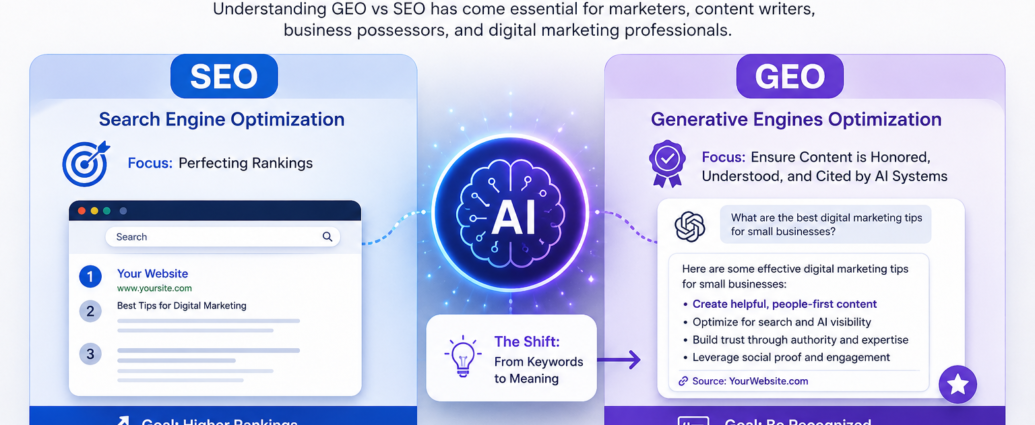
As a result, understanding GEO vs SEO has come essential for marketers, content writers, business possessors, and digital marketing professionals. While SEO focuses on perfecting rankings, Generative engines Optimization aims to ensure content is honored, understood, and cited by AI systems.
In this companion, we’ll explore the crucial differences in the GEO vs SEO debate, why GEO is gaining significance, and how content creators can prepare for the future of AI-driven search. , why GEO is gaining significance, and how happy generators can prepare for the future of AI- driven search.
What Is SEO?
Search Engine Optimization( SEO) is the process of perfecting a website’s visibility on search engines similar to Google and Bing. The primary thing of SEO is to rank advanced in search results for specific keywords and attract organic business.
Traditional SEO involves several factors :
- Keyword research and optimization
- Technical SEO
- Link building
- Content creation
- User experience improvements
- Mobile optimization
For times, SEO has helped businesses induce business, leads, and deals by icing their content appears prominently when users search for applicable motifs.
For illustration, if someone asks for” stylish digital marketing course,” search engines display web runners that they believe give the most applicable answer. SEO helps websites earn those positions.
Despite the emergence of AI search, SEO remains an important foundation for online visibility and continues to play a central role in the GEO vs SEO discussion.
What Is Generative Engine Optimization( GEO)?
Generative engines Optimization( GEO) is the practice of optimizing content so that AI- powered search engines and large language models can understand, trust, and reference it when generating responses.
Unlike traditional SEO, which focuses on rankings, GEO focuses on AI visibility. The thing is to make content precious enough for AI systems to cite, epitomize, or recommend in generated answers.
Generative engines Optimization emphasizes
- Contextual relevance
- Semantic clarity
- Authoritative information
- Structured content
- Fact-based answers
- Topical expertise
As AI search becomes more popular, businesses that apply GEO strategies may gain visibility, highlighting a major shift in the GEO vs SEO landscape.
GEO vs SEO Understanding the crucial Differences
When agitating GEO vs SEO, it’s important to understand that both approaches aim to increase happy visibility, but they achieve this thing else.
SEO Focuses on Rankings
SEO is designed to help content rank advanced on search engines affect runners. Success is frequently measured through
- Organic traffic
- Keyword rankings
- Click-through rates
- Conversions
GEO Focuses on AI Citations
Generative engines Optimization aims to increase the liability that AI systems will source your content when answering user questions.
Success is measured through
- AI citations
- Brand mentions
- Content visibility in AI- generated answers
- Authority within a content
Content Structure Matters More in GEO
Traditional SEO frequently emphasizes keyword placement and backlinks. GEO prioritizes
- Clear headlines
- terse answers
- Content depth
- Factually accurate information
- Strong semantic connections
The future of GEO vs SEO is n’t about choosing one over the other. rather, businesses should learn how both approaches work together.
Why GEO Is Arising Now
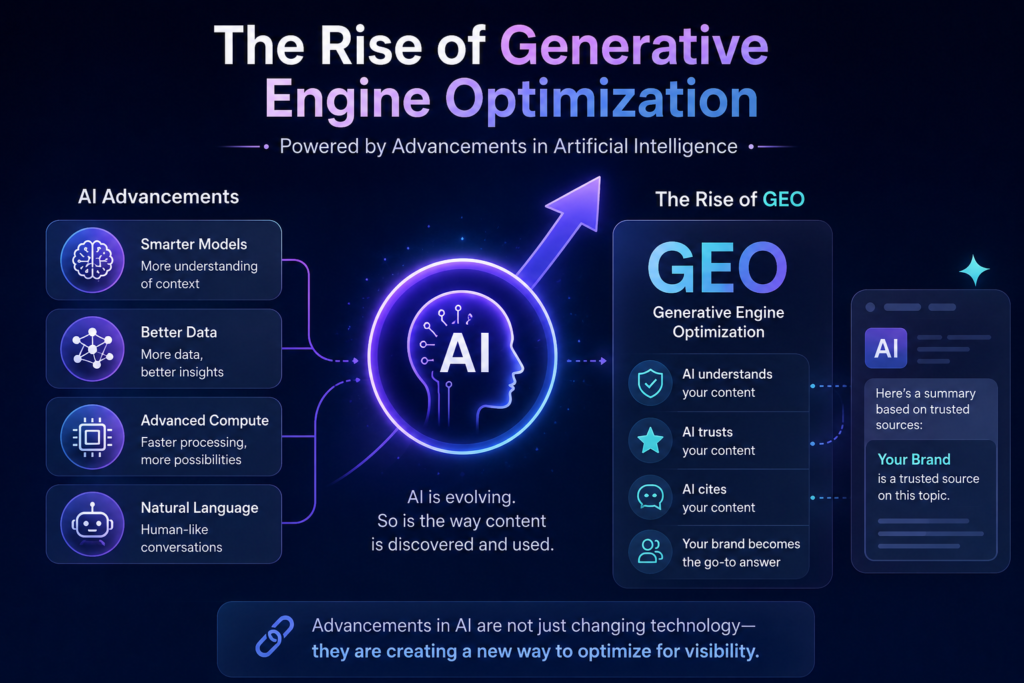
The rise of Generative Engine Optimization is directly linked to advancements in artificial intelligence.
Several factors are driving this change and reshaping the future of GEO vs SEO.
1. AI- Powered search Experiences
users now admit direct answers rather than lists of links. AI- generated summaries give faster access to information.
2. Changing user behaviour
People increasingly prefer conversational search. Rather than codifying keywords, they ask complete questions.
3. Better Language Understanding
ultramodern AI systems can understand environment, intent, and connections between motifs more effectively than traditional search algorithms.
4. Increased Competition
As further businesses invest in SEO, standing out becomes more delicate. GEO offers an fresh occasion to gain visibility.
These developments explain why conversations around GEO vs SEO are getting more common across the digital marketing assiduity.
How AI Search Engines Evaluate Content
To succeed in the evolving GEO vs SEO environment, it’s important to understand what AI systems look for.
Topical Authority
AI platforms prefer content from sources that demonstrate deep expertise in a specific subject.
Structured Content
Well- organized papers with clear headlines and logical sections are easier for AI systems to interpret.
Factual Accuracy
Reliable and empirical information increases trustworthiness.
Comprehensive Coverage
Content that completely answers user questions tends to perform better.
Original perceptivity
Unique exemplifications, case studies, and expert opinions help distinguish content from general papers.
These factors make Generative Engine Optimization different from traditional ranking- concentrated strategies.
Practical GEO Strategies for content writers
Content writers can begin optimizing for AI search today by adopting the following GEO practices and gaining an advantage in the GEO vs SEO era.
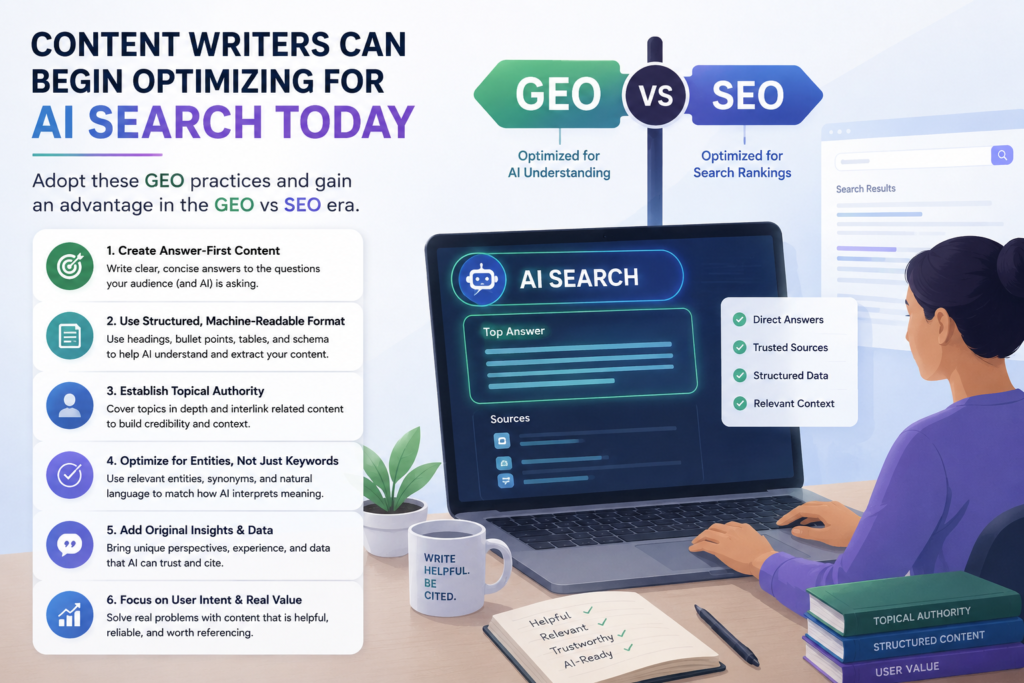
Write Question- Grounded Content
AI search frequently revolves around user questions.
exemplifications include
- What’s Generative Engine Optimization?
- How does GEO differ from SEO?
- Will GEO replace SEO?
Directly answering these questions improves happy relevance.
Create Content Clusters
rather than fastening on insulated papers, make comprehensive content ecosystems around core motifs.
For illustration, a GEO content cluster could include
- GEO vs SEO
- AI search optimization
- Semantic SEO
- Entity-based SEO
- AI content visibility
Improve Content Structure
Use
- Descriptive headlines
- Bullet points
- Tables
- Short paragraphs
- Clear summaries
These rudiments improve readability for both humans and AI systems.
Demonstrate E-E-A-T
Experience, expertise, Authoritativeness, and trustworthiness remain critical.
Include
- Author credentials
- Reliable sources
- Real-world examples
- Industry expertise
Focus on Entities and Context
ultramodern AI systems understand generalities and connections, not just keywords.
rather than repeating keywords exorbitantly, explain motifs completely and naturally.
Will GEO Replace SEO fully?
One of the biggest questions girding GEO vs SEO is whether Generative Engine Optimization will ultimately replace traditional SEO.
The answer is likely no.
SEO continues to play a pivotal part in helping search engines discover, crawl, and indicator content. Businesses still depend on organic search business to attract callers and induce profit.
Still, GEO is getting a decreasingly important subcaste of optimization.
Think of it this way
- SEO helps users find your content.
- GEO helps AI systems understand and source your content.
Associations that combine both strategies will have a stronger competitive advantage in the times ahead.
The Future of Search: GEO and SEO Working Together
The future of digital marketing will probably involve a combination of SEO and Generative engines Optimization.
Several trends are already emerging that will define the future of GEO vs SEO.
AI Citations Will Come Valuable
Brands will contend to come trusted sources for AI- generated answers.
Search Results Will Come Further Conversational
users will interact with AI sidekicks rather than counting solely on traditional search runners.
Authority Will Matter More
Trusted brands with high- quality content will profit the most from AI- driven search.
Content Quality Will overweigh Keyword Stuffing
The period of writing solely for algorithms is ending. Content must authentically help user while furnishing dependable information.
As AI technology continues to evolve, businesses that embrace both GEO and SEO will be more deposited to maintain visibility across multiple search gests .
Conclusion
The debate around GEO vs SEO is shaping the future of digital marketing. While SEO remains essential for achieving visibility in traditional search engines, Generative Engine Optimization is becoming decreasingly important in an AI-first world.
Generative engines Optimization focuses on helping AI systems understand, trust, and cite content. It rewards clarity, authority, environment, and comprehensive content rather than counting solely on keyword optimization.
Rather than replacing SEO entirely, GEO is emerging as the next evolution of search optimization, making GEO vs SEO one of the most important discussions in digital marketing today. . Businesses, marketers, and content writers who combine SEO stylish practices with GEO strategies will be stylish equipped to succeed as AI- powered search continues to transfigure how information is discovered online.
The future of GEO vs SEO belongs to content that effectively serves both users and intelligent systems. By understanding the differences between GEO vs SEO, you can produce content that remains visible, applicable, and precious in the times ahead.
Click Here to Read More Blogs Like This
For SEO Classes or SEO Services Click Here
FREQUENTLY ASKED QUESTIONS (FAQ’s)
Why is AI-powered search becoming more popular?
AI-powered search provides direct, conversational answers instead of requiring users to browse multiple websites. This saves time and improves the overall search experience.
How do generative search engines find reliable information?
These systems analyze content based on factors such as expertise, accuracy, relevance, authority, structure, and trustworthiness before using it in generated responses.
Can traditional optimization techniques still drive website traffic?
Yes. Search engines continue to rely on ranking signals such as content quality, backlinks, technical performance, and user experience. These factors remain important for attracting organic visitors.
What type of content performs best in AI-generated responses?
Content that is well-structured, factually accurate, comprehensive, and easy to understand has a better chance of being referenced in AI-generated answers.